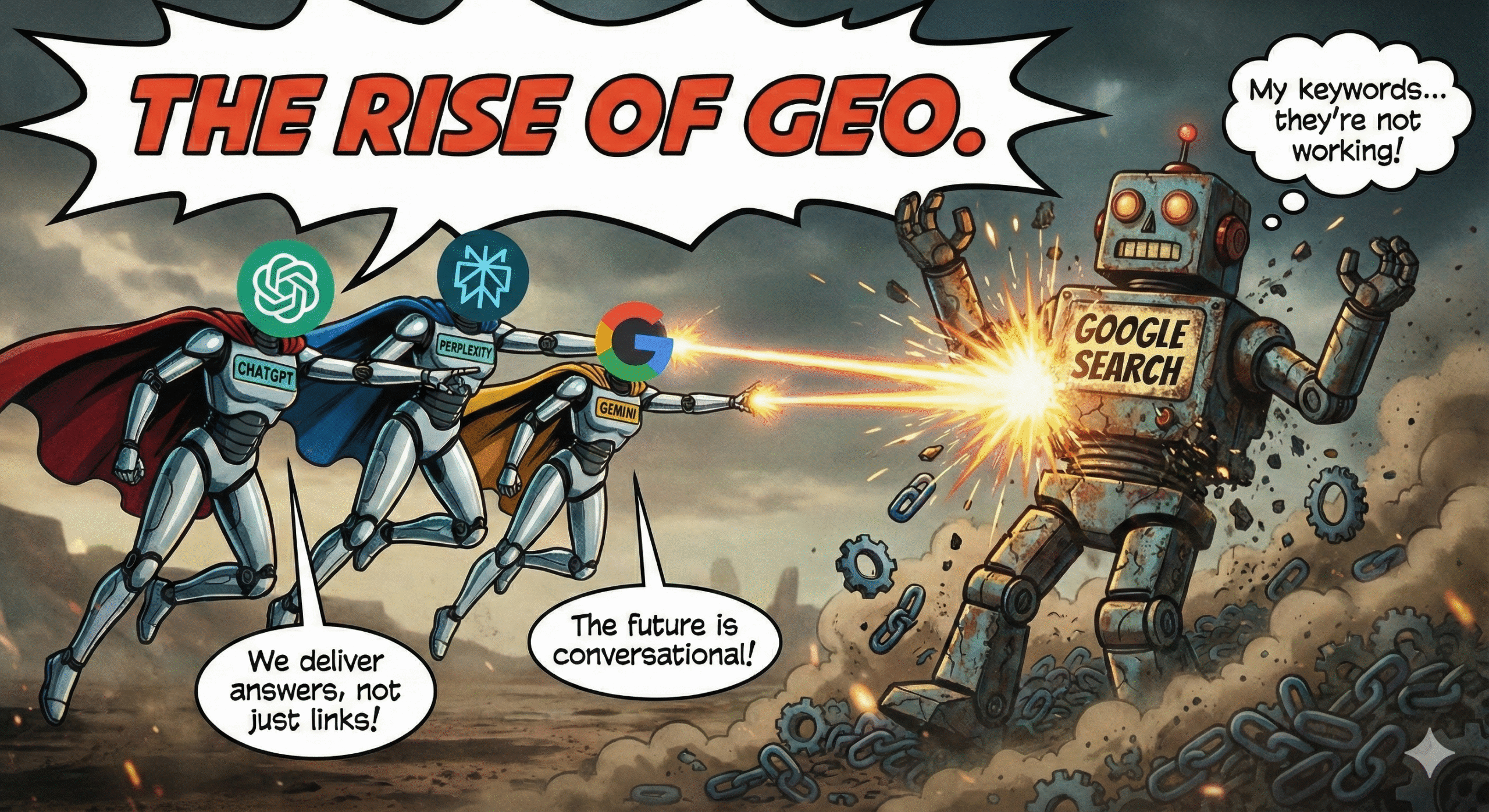
Let’s be honest.
You’ve probably noticed this: people are slowly stopping typing into Google… and instead, they’re asking things like:
“Hey ChatGPT, tell me how to write a content outline.”
“Explain this concept simply.”
“Which laptop should I buy for work?”
A few years ago, people would search this on Google.
Now? They ask generative engines.
Why?
Because Google gives links to websites, while generative engines give answers to people.
There’s a big difference.
Google Was Built for Links — Not Meaning
When someone types a query on Google, it still thinks like:
-
Match keywords
-
Show top-ranking sites
-
Display ads
-
Push traffic to external pages
Google is a librarian.
It tells you where a book is.
But generative engines — like ChatGPT, Perplexity, Gemini, Claude —
they ARE the book.
You don’t “search” —
you “converse.”
You don’t “scroll” —
you “understand.”
You don’t “click through” —
you “receive knowledge.”
This is a different behavior entirely.
People Don’t Want Search Anymore — They Want Solutions
On Google, you type:
“best exercises to reduce belly fat”
And you get:
-
20 blogs
-
6 YouTube videos
-
ads
-
more ads
-
people trying to sell stuff
But on a generative engine, you get:
A simple explanation, tailored to you
- follow-up suggestions
- clarifying questions
It remembers your input
It adapts
It personalizes
Google never talks to you.
Generative engines talk with you.
SEO Will Still Exist — But It Won’t Be Everything
Traditional SEO is:
-
keywords
-
backlinks
-
click-through
-
dwell time
-
meta tags
-
site structure
All important.
Still relevant.
But not sufficient.
Because generative engines are not ranking websites.
They are ranking ideas.
And they evaluate:
-
clarity of language
-
contextual meaning
-
topic depth
-
intrinsic intelligence
-
intent fulfillment
-
coherence
-
natural expression
This isn’t the “keyword stuffing” era anymore.
This is the “meaningful writing” era.
This Is Where Generative Engine Optimization (GEO) Comes In
If SEO is about searching the internet,
GEO is about teaching the internet.
It asks:
-
Can AI understand your content?
-
Can it summarize it correctly?
-
Can it reference it?
-
Can it transform it?
-
Can it reuse it logically?
Keywords don’t help here.
Clarity does.
Structure does.
Intent does.
AI needs to understand you, not just index you.
Google Is Already Feeling The Pressure
For the first time since 1998, Google’s dominance is being challenged.
Not by another search engine.
Not by Bing.
Not by DuckDuckGo.
But by an entirely different category:
generative knowledge engines.
You don’t browse the internet through them —
You digest it through them.
AI is becoming the interpreter between humans and information.
The Real Future?
I’ll tell you straight:
People will still use Google.
But not for thinking-based queries —
only for:
-
transactions
-
shopping
-
flights
-
maps
-
brand websites
-
local businesses
-
events
Anything conceptual, explanatory, educational, comparison-based —
That goes to generative engines.
The Takeaway
If you write content for HUMANS ONLY, you lose.
If you write content for ALGORITHMS ONLY, you lose.
If you write content for both —
You win.
And that’s where GEO becomes a future skill.